|
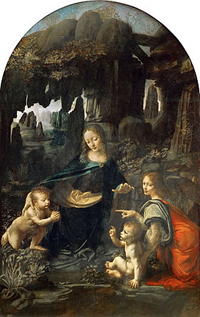
The Virgin of the Rocks 1483-1484/85Oil on wood, transferred to canvas, 197.3 x 120cm Paris, Louvre
The Louvre is a huge museum, and it is not the kind of museum that can be toured in a day. This painting is exhibited in a corner of the huge museum called the Denon Wing, but while there is a constant line of tourists in front of the popular Mona Lisa, there are only occasional visitors in front of the Virgin of the Rocks, and it was never crowded at all. The reason for this is that the corner where this painting is displayed is a little further back, and since many of the popular paintings are displayed on the other side of the Mona Lisa, it is inefficient to have to go around to the back to get to this side. However, because it is not popular, I can monopolize the special seat in front of this painting until I feel satisfied every day, so the Virgin of the Rocks was in the best display position for me at that time. The Virgin of the Rocks was originally an altarpiece, so the painting itself is large, but it is also surrounded by a wide frame, making the overall size quite large. The frame of this painting is unique, with a three-dimensional structure that juts out quite far forward, giving the impression that it was brought over as an altarpiece. Also, I was told that there were some parts of the painting that were damaged when it was transferred from the board to the canvas, but as far as I could see, there did not appear to be any such damage on the screen. This painting is a monumental masterpiece that marked the completion of Leonardo's art, and its high level of completion is unmatched among his works. Leonardo also painted St. Anne and the Virgin and Child in his later years, but in terms of the detailed depiction of the painting, the Virgin of the Rocks is far superior. The details around the infant Jesus and John are particularly wonderful, and no matter how close you get and squint, the shading is so delicate and detailed that it is hard to believe it was painted by human hands, and the boundaries are completely indistinguishable to the naked eye. It is impossible to imagine how this painting was painted, and it can only be described as superhuman. I felt that I would never be able to paint even a single blade of grass around the feet of the infant Jesus, even if I spent my whole life doing so. This painting made me strongly realize that it all depends on whether you are born with talent or not. This painting also has special features not only in the depiction of the people, but also in the overall depiction of the landscape. Italian paintings, especially those centered around Florence, are characterized by bright scenes filled with light, but on the other hand, north of Milan, there is a strong influence of Flemish painting, and instead of bright, shining landscapes, they are characterized by the depiction of dim, quiet, and cold spaces. This painting also has those Milanese painting characteristics, and has a quietness that makes you feel that there is a cold air between the painted object and the viewer. The wonderful depiction of the hair, the magnificent expression of the fingers, and the perfect depiction of the clothes, this painting can be said to be a monumental work that shows one of the achievements of Leonardo's art in all respects.
|

leonardoresearch.jp